
UMN Rochester’s Creativity Studio is a catalyst for turning inspiration into creation and creation into community.
UMR’s Creativity Studio, located in Room 7 of 318 Commons, offers weekly open studio time each Thursday from 5:30 to 8:30 p.m. Students can explore art projects with provided supplies and are welcome to bring their own materials. Review the studio’s schedule and guidelines before attending.
Available Art Supplies
Student Projects in Action
Creativity Studio work is integrated into the learning experience at UMN Rochester. Creative practice supports course concepts and hands-on exploration.
BIOC 3721 Visualizing Biomedicine’s Molecular Landscapes
Term: Spring 2025
Instructor: Cassidy Terrell
Project description:
Students in BIOC 3721 created works of art that depict how 2024 FDA‑approved drugs function alongside the disease states they treat. Inspired by David Goodsell’s molecular illustrations, these landscapes represent the inner workings of the cell at a moment in time, with structures shown to accurate size, scale and concentration, with some creative freedoms taken. The aim is to blend scientific accuracy with artistic expression. Through the process of visualizing biomedicine, student‑artists deepened their understanding of complex scientific concepts and translated them into visual form, offering audiences a unique pathway into the invisible worlds of biomedicine.

BIOL 4340 Mushrooms, Moochers and Virology
Term: Fall 2024
Instructors: Rachel Olson and Micaela Haas
Project Description:
As a capstone for the Mycology, Virology and Parasitology course, students selected a favorite organism or biological concept to transform into a visual story. Faculty strove to form a creative intersection where students bridge scientific discovery and artistic innovation. Utilizing a vibrant mix of media, from paintings and intricate beadwork to detailed 3D models, they translated complex cellular structures, life cycles, and scientific theories into tangible art. This hands-on, multi-sensory project offered a memorable, integrative way to conclude the semester, proving that scientific understanding and artistic expression naturally enrich one another.

CAP 1000 Academic Inquiry into the Health Sciences (Section 8: Creativity and Curiosity)
Term: Fall 2025
Instructor: Aaron Bruenger
Project description:
In this activity, Making Monsters, students chose something they worry about, do not understand or dislike when they see it in others. They created clay monster sculptures to represent those concerns. The goal was to make worries feel more manageable by giving them a tangible form.
Through the design process, students explored the complexity of their concerns and learned the importance of having a nuanced view of themselves. They also practiced finding ways to make challenges more manageable during times of stress and struggle.
Example 1

Example 2

Concept: Procrastination Monster
Name: Aplazar
Description: Aplazar is a one-eyed bipedal creature with a blue and green color palette. Its arms are covered in light blue scales, with the same shade on the front of its upper body. The color shifts to a darker blue on the lower body and upper back. A bright green tail runs up its spine and neck, stopping at the head, with darker teal scales at the tip. Aplazar’s feet are oversized for its small frame, a sign of immaturity. It wears a watch with a black band. The face has no numbers, only the words “almost late.” Aplazar constantly glances at the watch, thinking “I’ve got time” even when time is short.
Personality: Aplazar is laid back and ignores deadlines, always believing there is time to spare. It prioritizes fun with friends or entertainment over work.
Positives: Aplazar’s poor time management makes it easygoing and fun to be around. It is smart and generally enjoyable company.
Negatives: Aplazar struggles with time management. It often scrambles to finish assignments at the last minute or delays completing them until later.
CAP 1000 Artist Mindset & Health
Term: Fall 2025
Instructor: Yuko Taniguchi
Project Description: Considering that many college students struggle with perfectionism, this first-year seminar examined the unhealthy habits that perfectionism could create and introduced a new approach: Wabi Sabi, a Japanese philosophy that recognizes the old, the broken and the imperfect as sources of character and wisdom. Through this framework, students explored how imperfection is not only natural but also essential, an important sign of authenticity and a key ingredient for creativity.
To practice this concept, students followed step-by-step instructions to make origami flowers (a task perfectionists often want to execute flawlessly). They were then invited (actually required!) to rip their origami flowers and transform them into new, interesting forms. After this playful exploration of tearing and reshaping, each group collaborated to combine their ripped flowers into a shared “garden” that tells a story about confronting perfectionism and embracing self-compassion.


ENGL 1433 Introduction to Literature course
Term: Fall 2025
Instructors: Marcia Nichols and Jen Wacek
Project Description:
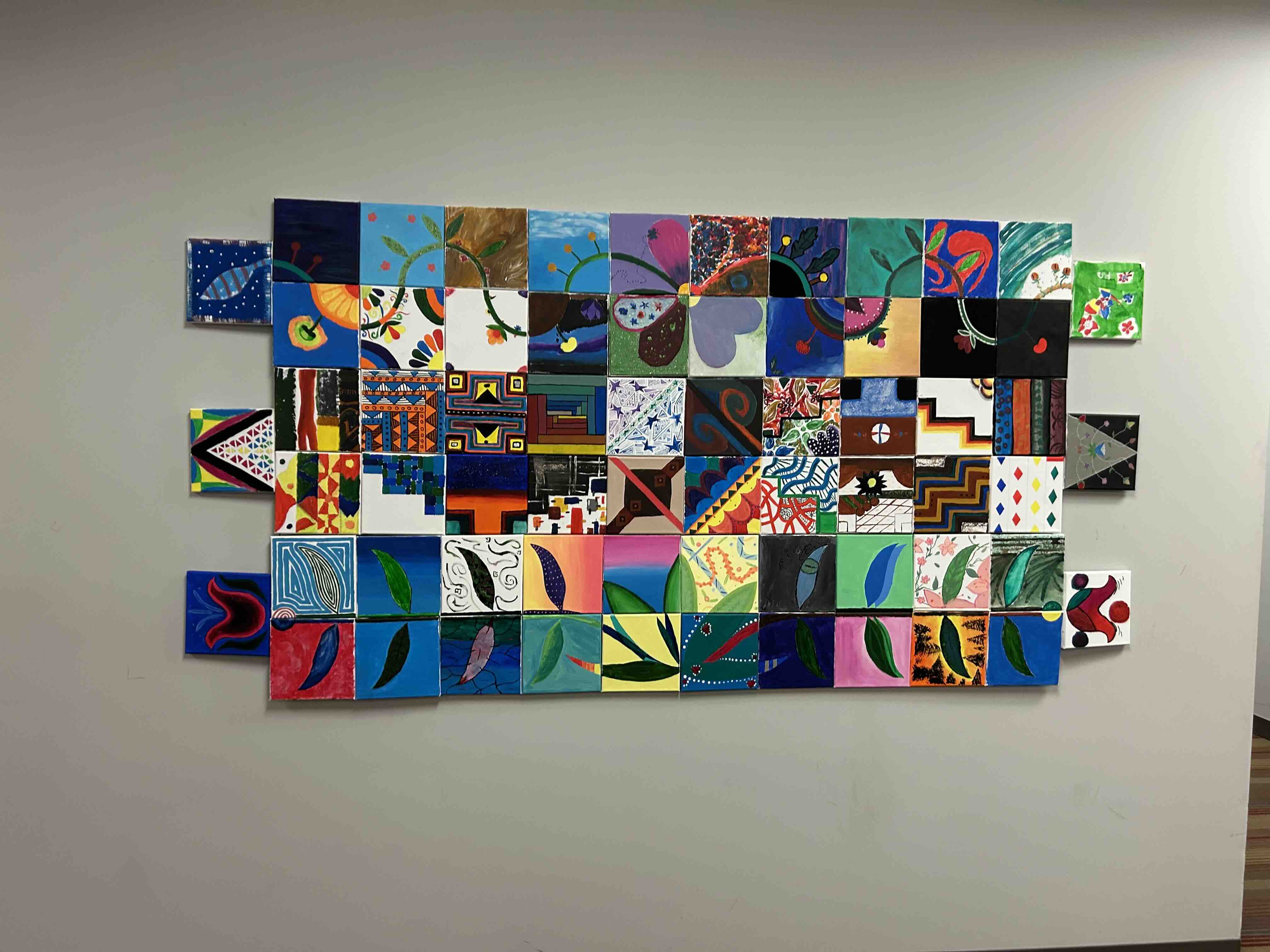
As the culmination of a unit on Native American literature, students participated in an artistic workshop with scholar and artist Biiwaabik Hunt (Ho-Chunk, Ojibwe, Lakota).
Biiwaabik designed a community mural featuring Ojibwe and Dakota design traditions and composed of individually-painted canvases. Together, they form a beautiful, collective work showcasing the importance of community and connection.
Through this process, student-artists deepened their understanding of Minnesota tribes’ histories, artistic traditions and recognized the continued vitality and contributions of Native peoples.

HIST 1435 Comparative Global History: Trauma, Resistance and Resilience in Historical Narratives through Art and Creativity
Term: Fall 2025, Spring 2026
Instructors: Jim Ford, Yuko Taniguchi
Project description:
Students examined genocides through historical scholarship and creative expression. They studied accounts alongside works produced by survivors to deepen their understanding of trauma, resistance and resilience. For their final project, students created “music boxes” to capture the wisdom and insights they gained. They explored how artistic choices such as symbolism, texture, color, sound and design can communicate the complex dimensions of historical trauma. Through this work, students showed how creativity can capture insights often difficult to express in conventional formats like research papers, making their historical learning personal and deeply meaningful.

HUM 3401 Contemplation of Mental Health Using Creativity and Qualitative Analysis
Term: Spring 2017-Fall 2026
Instructors: Yuko Taniguchi and Jered Bright
Project Description:
As the signature final project for this course, students contemplated their own well-being by exploring the following questions:
- If a student's well-being were visible, what would it look like?
- What is the shape of their well-being space?
- What is the range of their well-being?
The purpose of this project is to encourage students to think about the boundaries of their well-being. By representing well-being as a visible space, students can "see" where they stand in relation to it. A big focus of this course is to help students genuinely understand how it feels to be well, and from that place, to think about how they might help others.


HUM 4301 Creativity and Facilitation in Community Settings
Term: Spring 2025
Instructors: Jered Bright, Elizabeth Dunens, Yuko Taniguchi
Project Description:
Students collaboratively develop, facilitate and evaluate creativity-based programs for students at the Alternative Learning Center (ALC). The course covers three core areas: designing effective content tailored to a target audience, facilitating diverse groups — from small discussions to large workshops — and evaluating program impact. Through this process, students build leadership, attentiveness, creativity and communication skills essential for navigating health care in the digital health era.


MATH 1121 - Precalculus II
Term: Spring 2026
Instructor: Chris Ballam
Project Description:
As part of an extra‑credit opportunity in Precalculus II (Course 1121), students were invited to creatively express their individual learning experiences and engagement with mathematics. The work was not a classwide project, but an open‑ended option shaped by each student’s interests and mathematical perspective.
Jay Crump chose to explore her experience through drawing and painting, a medium she valued and felt connected to as an artist. An initial, undefined idea evolved over several weeks of conversation between Crump and Professor Ballam into a finished piece that blended her mathematical learning with her artistic practice. Crump had full ownership of the project’s concept, medium, direction and scope, determining how she wanted to represent and communicate her experience with mathematics.
Title: If Failure Could Sing Medium: Acrylic paint Year: 2026
“This work explores the tension between equations and resilience, showing how failure can transform into grace.”

